December 4, 2025
2 min read
Add Us On GoogleAdd SciAm
Can We Image Alien Earths? This Newfound Object Could Show the Way
Using direct imaging, astronomers have found a brown dwarf that could help test technology for taking snapshots of Earth-like exoplanets
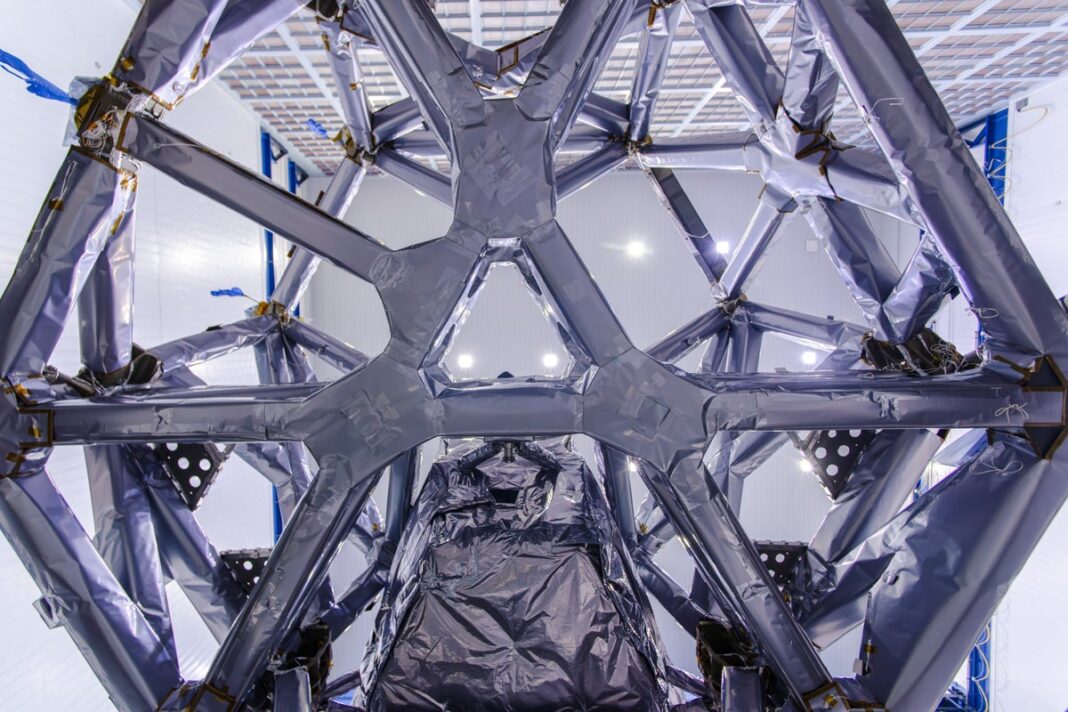
The coronagraph for NASA’s Roman Space Telescope will allow the observatory to take snapshots of giant exoplanets.
Astronomers have found what could become the first target for a crucial test of NASA’s upcoming Nancy Grace Roman Space Telescope, a soon-to-launch observatory that serves as a pathfinder mission for discovering Earth-like worlds around other stars.
In a pair of new studies, an international research team has revealed two newfound objects around nearby stars: a gas-giant exoplanet orbiting the star HIP 54515 and a brown dwarf around the star HIP 71618. It is the latter of these, the brown dwarf, that could prove the perfect test bed for Roman, says Thayne Currie, an astrophysicist at the University of Texas at San Antonio and co-author of the studies. Both discoveries relied on fresh observations from a planet-imaging instrument at Japan’s Subaru Telescope in Hawaii, as well as archival data from the European Space Agency’s Gaia spacecraft.
When it soars into orbit as early as next year, Roman will carry an instrument called a coronagraph, which is designed to blot out most of a star’s bright glare so that the far fainter light from accompanying planets can be seen. Roman’s coronagraph is a critical precursor for more ambitious starlight-blocking hardware planned to fly on another future NASA mission, the Habitable Worlds Observatory, which could launch in the late 2030s to discover, image and study potential Earth twins around dozens of sunlike stars.
On supporting science journalism
If you’re enjoying this article, consider supporting our award-winning journalism by subscribing. By purchasing a subscription you are helping to ensure the future of impactful stories about the discoveries and ideas shaping our world today.
To test Roman’s coronagraph—and thus the feasibility of its planned follow-up—scientists need to show it can spot objects in close proximity to (but 10 million times fainter than) their host stars. The brown dwarf, Currie explains, is essentially a dim “failed star” that’s neither too close nor too far from its stellar host, putting it at exactly the right distance and brightness for Roman to show its stuff.
“It’s going to test technologies that we will need to be able to image an Earth,” Currie says.
The discoveries show just how far the search for worlds beyond our solar system has progressed, says Rebecca Charbonneau, a historian of science at the American Institute of Physics. In particular, the direct-imaging techniques used to discover these two objects mark a major step forward for the field, which still mostly relies on other, indirect methods, such as tracing wobbles in a star’s celestial motion to find exoplanets.
“Direct imaging allows us to see these worlds themselves, which is historically significant not just as a technical milestone but as a shift in how we study distant planetary systems,” she says.
It’s Time to Stand Up for Science
If you enjoyed this article, I’d like to ask for your support. Scientific American has served as an advocate for science and industry for 180 years, and right now may be the most critical moment in that two-century history.
I’ve been a Scientific American subscriber since I was 12 years old, and it helped shape the way I look at the world. SciAm always educates and delights me, and inspires a sense of awe for our vast, beautiful universe. I hope it does that for you, too.
If you subscribe to Scientific American, you help ensure that our coverage is centered on meaningful research and discovery; that we have the resources to report on the decisions that threaten labs across the U.S.; and that we support both budding and working scientists at a time when the value of science itself too often goes unrecognized.
In return, you get essential news, captivating podcasts, brilliant infographics, can’t-miss newsletters, must-watch videos, challenging games, and the science world’s best writing and reporting. You can even gift someone a subscription.
There has never been a more important time for us to stand up and show why science matters. I hope you’ll support us in that mission.