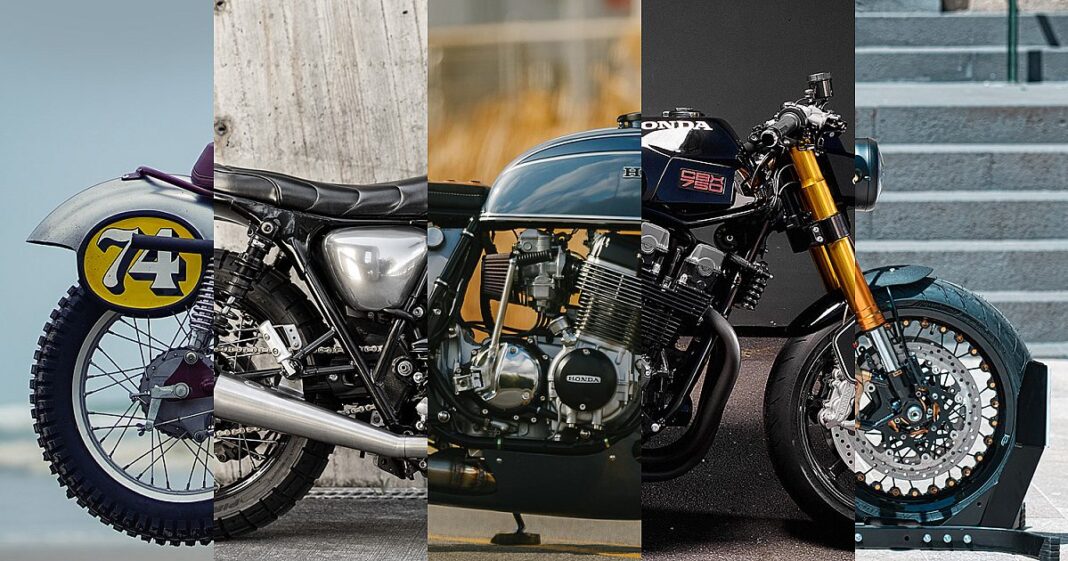
That’s another month in the books, and you know what that means; it’s time to crunch the numbers and see which builds really struck a chord with our readers over the last 30 days. The top performers of November look a bit different than October (namely, the lack of any choppers), but I’m happy to report that café racers have made a strong showing once again.
If there’s another takeaway from this month’s lineup, it’s the impressive array of unconventional donors, including a GT185, a CBX750 and even an XV1000 TR1. I suppose it’s not where you start, but where you end up, so join us in a victory lap for our top custom builds of November.
1974 Suzuki GT185 by Knuckle Whackjob
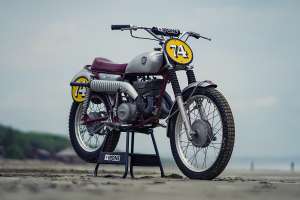
When Knuckle Whackjob in Jakarta dropped their rebuild of the 1974 Suzuki GT185 into our inbox, it looked at first like a simple ’70s scrambler refreshed—until you notice the diminutive two-stroke twin tucked in where a single would normally sit. Born as an underdog road bike in Suzuki’s mid-’70s GT range, the GT185 was never intended for off-road use. But that’s exactly what this build became: a speculative 184 cc two-stroke twin enduro that Suzuki never made, reworked from the bones of a commuter.
Under the custom tank and aluminum bodywork, the original air-cooled twin remains. Knuckle Whackjob revived it with stock Suzuki parts, rebuilt carbs and a cleaned set of cases while retaining the factory oil-injection system. The frame stays mostly original but now sits on extended forks and taller rear shocks sourced from a Harley. Shinko SR241 rubber and a new 19-inch front hoop complete the stance of a lightweight scrambler.
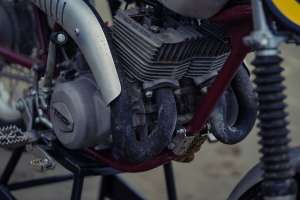
The team fabricated a new aluminum gas tank, side covers and oil tank with clean, purposeful lines that define the bike’s new character. Chrome motocross bars and a trimmed bench seat sharpen the ergonomics, both handbuilt, and twin expansion chambers run high along the right side with simple, factory-looking heat shields. The overall finish lands in a practical zone—brushed engine cases, maroon paint on the bodywork and raw aluminum where it matters.
Taken as a whole, the build reads less like a restoration and more like a careful reinterpretation. Starting with a forgotten platform and drawing inspiration from Triumph’s storied desert sleds, Knuckle Whackjob created a subtle, one-off interpretation of a bike that could have been—and created one of this year’s most memorable small-displacement customs in the process. [More]
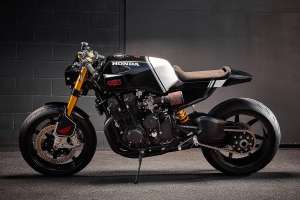
1984 CBX750F by Ellaspede
The Honda CBX750 has always flown under the radar, a mid-’80s sport tourer with a 747 cc DOHC four, shaft drive and hydraulic valve adjusters. But when Colm, a client from Ireland, approached Ellaspede about building a custom CBX, they were up for the challenge. Colm’s vision for the project was simple: it needed to retain the signature square headlights and be something the Ellaspede crew would be happy to own themselves.
Proper donors proved to be in short supply, and Ellaspede eventually opted to ship one from Japan to Brisbane. While the bike was in transit, they amassed a collection of trick parts to make the CBX perform, including a Ducati 1198 swingarm, an Öhlins front end for a BMW R nineT and BST carbon wheels.
The build began with a full strip down of the 1984 CBX750F. The stock rear subframe was removed and replaced with a custom tubular unit, while the rear suspension was converted to a single shock. At the front, the geometry was adjusted with a revised neck to accommodate the updated forks and handle precise rake and trail. The frame tweaks ensured that the Ducati swingarm, Öhlins fork and BST wheels would all work in harmony, lowering unsprung mass and sharpening handling.
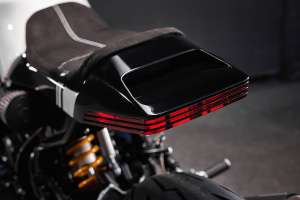
Ellaspede also reimagined the bodywork and intakes. The tail and side panels were sketched, designed and 3D printed before the final components were shaped from aluminum. Inspiration was drawn from the ’80s, most notably the Ferrari Testarossa, and its influence can be seen on the landmark tail section, tank flares and custom CBX750 badging. The side covers were designed in the same fashion, incorporating scallops to accommodate the massive K&N filters and custom two-into-one CNC-machined manifolds.
Since the DOHC 750 had lost its edge after all these years, Ellaspede sent it off to Stuart Firth of Firth Racing for a proper overhaul. Fully tuned in its new specification, the engine breathes through a four-into-one Yoshimura exhaust and has a full suite of Motogadget electrics.
With that, just one request from Colm remained: those square headlights, and Ellaspede put their own unique touch on them. The final product draws inspiration from the Viewmaster toy and incorporates LEDs and CBX badging. The effort placed on this single component reflects Ellaspede’s devotion to its client’s vision and the depth of design of this project. So much more than just a killer CBX, it’s one of our most notable customs this month. [More]
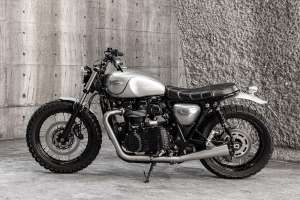
2016 Triumph Street Twin by 2LOUD Custom
The 2016-model Street Twin from Triumph’s modern-classics stable was always a solid, simple roadster—but 2LOUD Custom in Taiwan has shown just how much this twin can shine with the right subtle reworks. Although it’s the first time 2LOUD’s Ma ‘Max’ Yicheng has worked with a modern liquid-cooled Street Twin, he’s undoubtedly written a solid formula for replication.
The first step was chassis surgery: the stock subframe was shortened with a custom looped unit, the rear shocks swapped for a bespoke GJMS set, and the front forks were shaved, shortened and painted black. These changes, combined with new geometry, sharpen the bike’s stance while retaining enough structure for a passenger if needed.
Wheels and suspension got a full overhaul as well. The stock cast alloys were swapped for spoked rims—18-inch up front, 17-inch out back—finished gloss-black with stainless spokes. Pirelli Scorpion Rally STR tires give the Street Twin a tougher, more purposeful look, and a Beringer front caliper and upgraded 2SPEED discs improve braking performance.
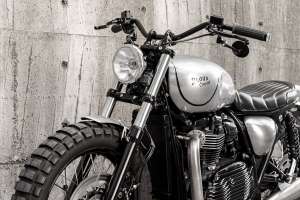
Bodywork and ergonomics were minimalist but deliberate. The original fuel tank remains, but its seam was removed for a cleaner profile, and fenders are handmade brushed-aluminum pieces sealed under clear coat. New aluminum side covers, a slim custom seat pad and simplified electrics tidy up the rear end. The headlight is a vintage-style unit from BAAK with an integrated Motogadget speedo, while controls and microswitches come from Frando. Subtle Motone finned engine covers and a stealthy stainless-steel twin-pipe exhaust complete the transformation.
Put together, 2LOUD’s Triumph isn’t about radical performance or wild visual transformations—it’s a masterclass in restyling—and there are scores of Street Twins on the market begging for the same treatment. [More]
1982 Yamaha XV1000 TR1 by Jerem Motorcycles
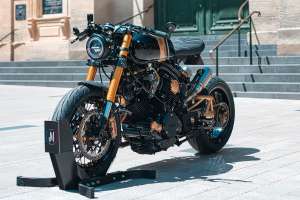
The 1982 Yamaha TR1 arrived from Yamaha as a curious blend—a 980 cc, air-cooled 75° V-twin tourer in the broader Virago lineage, with a backbone frame, single-sided swingarm and chain drive. When Jérémie Duchampt at France’s Jerem Motorcycles got his hands on one, he didn’t see a mid-’80s tourer waiting to be dusted off. He saw a blank canvas—a chance to prove the TR1 could shed its cruiser awkwardness and emerge as a taut, rowdy café racer.
The first step was a full nuts-and-bolts strip down. The engine got a fresh set of bearings, and the carbs were rebuilt with pod filters in place of the stock airbox. Turning his attention to the frame, Jérémie chopped the stock subframe and removed all factory tabs before sending it out for sandblasting and powder coating. A custom bolt-on rear loop now supports a solo seat and dramatically shortens the profile.
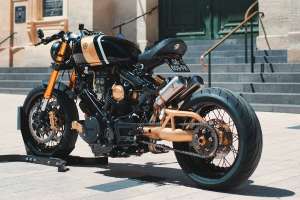
Front and rear suspension systems were completely reworked. Rebuilt GSX-R forks with gold anodized tubes were installed up front, while a trellis single-sided swingarm from a Ducati Monster S2R and a rear shock from an MV Agusta were retrofitted in the rear. Wheels were replaced with custom-laced rims from Italian builder Kineo, finished with gold accents and wrapped in Dunlop Qualifier Core rubber, the rear now swelling to a 180-section tire.
The body got the kind of tasteful aggression this build demanded, including a fuel tank plucked from a modern Royal Enfield 650, hand-finished saddle, a USV Racing top clamp with clip-on bars, minimalist LED lighting and tidy bar-end switches and mirrors. Then there’s the serpentine exhaust, consisting of stainless steel headers mated to a pair of IXIL IXRace mufflers tucked neatly under the seat.
All said, Jérémie spent 300 hours on the build, and the end product is far from a half-hearted makeover; it’s a dramatic departure from the TR1’s touring disposition, and probably one of the quickest Virago-derived machines out there. [More]
Honda CB750 Café Racers by Mile Zero Racers
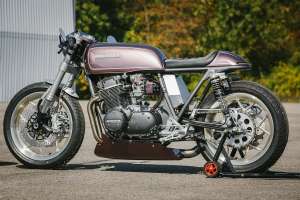
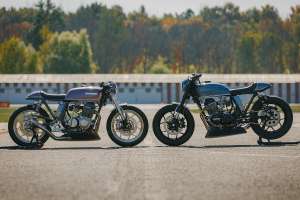
When Mile Zero Racers founder Thomas Manno first dropped his 1970s-era Honda CB750 café-racer concept, it felt like a one-off passion project. But with the new ClubSport V2 series, he’s proven it’s a deliberate, evolving philosophy—and he’s now offering not one but two polished builds that showcase the full potential of the CB750 platform.
The first bike, dubbed V2 Dot 1, uses a 1976 CB750F donor under a shimmering BMW Velvet Orchid Metallic paint job. The second, V2 Dot 2, builds from a 1977 CB750K, dressed in Porsche-inspired Baltic Blue metallic and tuned for a more upright, longer-ride stance. Despite their different donor years and ergonomics, both share a core upgrade philosophy: performance, handling and distinctive style over nostalgia.
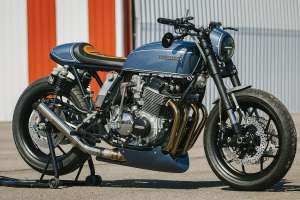
Under the skin, both machines get reworked running gear. Stock front forks are replaced by repurposed Kawasaki ZX-6RUSD forks, fitted to Mile Zero–machined custom yokes. Rear suspension is handled by adjustable YSS shocks. To improve braking, the builds use refurbished Nissin calipers at the front with new rotors, and rebuilt OEM CB750 calipers at the rear. Wheels? Mile Zero engineered their own 18-inch forged billet rims, wrapped in Bridgestone Battlax BT-46 rubber—a setup that balances modern grip without pulling the CB too far from its era.
The custom touches go deeper. Each bike features an MZR-designed top yoke—Dot 1 gets clip-ons for a sporty posture, while Dot 2 uses risers and more relaxed handlebars to suit longer rides. Both include clean modern electronics, including a Revival Cycles harness, Motogadget mo.unit Blue controller, Antigravity battery, Dynatek coils and weather-sealed Deutsch connectors. Lighting, controls, indicators and other details are also sourced from Motogadget and Choice City Moto.
Cosmetically, the builds stay sharp. Each has custom aluminium bodywork: matching front fenders, belly pans, side covers and 3D-printed headlight cowls that marry classic CB silhouette with modern finesse. The rear is finished with slim tail sections—Dot 1 uses recessed three-in-one LED tail-lights, while Dot 2 opts for an integrated strip light with signals built-in. Oil tanks are swapped for Cognito units beneath the seats, side covers camouflage intake pods feeding DNA filters and the signature CB750 four-cylinder heart remains front and center.

Considering each bike has a slightly different purpose in mind, it’s logical that Mile Zero outfitted the engines to differing specifications. The more road-friendly Dot 2 received a full rebuild to factory specs with a four-into-one Delkevic exhaust, while the Dot 1 is fit with oversized pistons, an upgraded cam and slotted cam sprocket, stage two head porting and Keihin CR29 carbs. Its exhaust is a screaming four-into-one system from MotoGP Werks.
In the end, the two ClubSport V2s show what happens when you respect a donor’s history—but aren’t afraid to rewrite the rulebook. For anyone chasing a practical CB750 with soul, handling and thoughtful engineering, stake your claim now, as just eight build slots remain. [More]