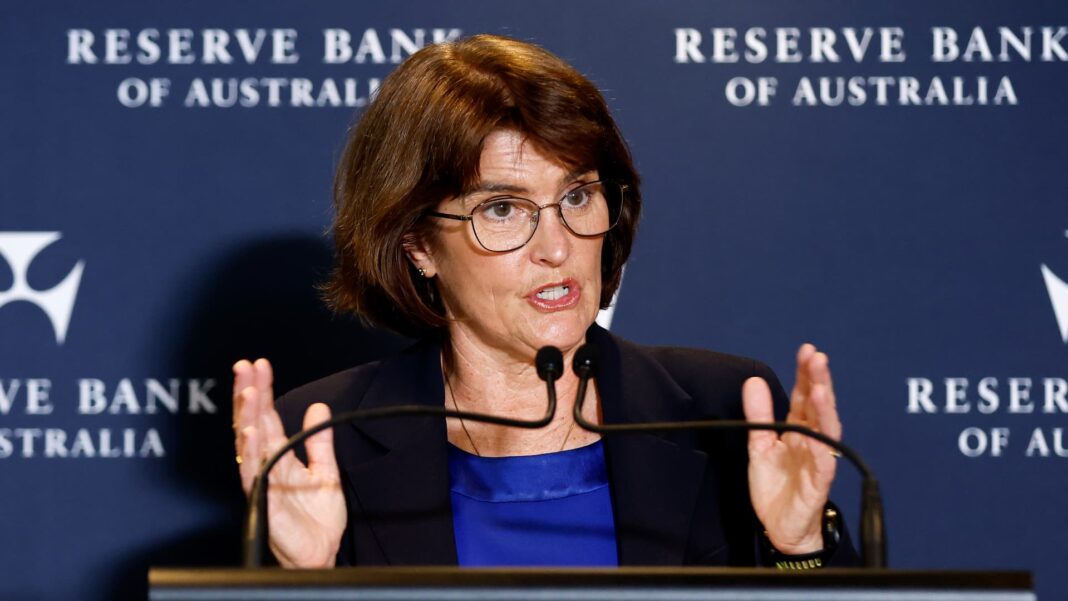
Michele Bullock, governor of the Reserve Bank of Australia (RBA), speaks during a news conference at the bank’s head office in Sydney, Australia, on Tuesday, Apr. 1, 2025.
Bloomberg | Bloomberg | Getty Images
Australia’s central bank cut its policy rate by 25 basis points to the lowest in two years as inflation concerns in the country continue to recede, giving room for the bank to ease monetary policy.
The Reserve Bank of Australia cut the benchmark rate to 3.85%, its lowest level since May 2023, in line with expectations from economists polled by Reuters.
Australia’s inflation has been on a downtrend, with the most recent headline inflation figure coming in at a four-year low of 2.4% in the first quarter of 2025.
The RBA said in its previous monetary policy statement that returning inflation sustainably to its target of between 2% and 3% “within a reasonable timeframe” is its highest priority, although it also acknowledged that the outlook was uncertain.
The Australian economy has also seen somewhat of a turnaround, with the most recent GDP reading showing a 1.3% year-on-year expansion in the fourth quarter and marking its first expansion since September 2023.
However, analysts, ahead of the RBA meeting, have highlighted downside risks for the Australian economy due to global trade tensions and uncertainty around the domestic economy.
In a May 16 note, HSBC analysts noted that “the global economy and financial markets have had tumultuous times” since the RBA’s last meeting on April 1, including the imposition — and subsequent suspension — of U.S. President Donald Trump’s “Liberation Day” tariffs.
The analysts forecasted a “modest negative growth impact” on the country, and said that the market shocks are likely slightly disinflationary for Australia.
This is due to weaker expected global growth and trade diversion of manufactured goods from China into non-U.S. markets, including Australia.
Carl Ang, Fixed Income Research Analyst at MFS Investment Management, also noted in a May 15 note that downside risks and uncertainty around Australia’s economic outlook have increased substantially, due to “Liberation Day” and global trade policies.
This will likely prompt a “tangibly dovish pivot from the RBA,” he said, forecasting that the central bank will reach a terminal rate of 3.1% in early 2026.
This is breaking news, please check back for updates.